Upgrade to BigCommerce Catalyst for Lightning-Fast Store Performance and a 100 Lighthouse Score
eCommerce website performance and speed are business imperatives in a highly competitive business landscape. They are a major part of the user experience. Without instant page loads and overall site responsiveness, customers lose interest, and search engines downrank your site in search results, causing a ripple effect across discoverability, search visibility, customer satisfaction, user experience, and conversions.
Even minor delays can have a substantial impact on your eCommerce business. That is why it is indispensable to have a standardized method for evaluating website performance across all parameters. Google Lighthouse is the auditing tool that serves this purpose.
This article explains why BigCommerce Catalyst is the ultimate platform upgrade for achieving lightning-fast storefront performance, consistently high Google Lighthouse scores, and stronger Core Web Vitals. It shows how Catalyst’s headless, Next.js-powered architecture improves SEO, accessibility, and business growth.
Understanding Google Lighthouse
Website responsiveness, speed, and visual stability are measured using the Core Web Vitals, which include these metrics: Largest Contentful Paint (LCP), Interaction to Next Paint (INP), and Cumulative Layout Shift (CLS). While achieving good Core Web Vitals is crucial, given that Google increasingly prioritizes them, it is not a comprehensive way to holistically evaluate website performance. Google offers a broader, lab-based evaluation tool for that, called the Google Lighthouse.
Google Lighthouse is an automated auditing tool that evaluates:
1. Performance
Performance is measured using these metrics: Core Web Vitals, First Contentful Paint (FCP), Speed Index, and Time to Interactive.
2. Accessibility
Site accessibility can be evaluated based on semantic HTML, ARIA attributes, color contrast, keyboard navigation, and screen reader compatibility.
3. Best Practices
Google Lighthouse evaluates the best practices followed in your site’s design, including security, modern web standards, safe JavaScript usage, and browser compatibility.
4. Search Engine Optimization (SEO)
Evaluating the SEO performance of your site involves checking its crawlability basics, including meta tags, mobile friendliness, indexability, and structured content.
What Does a Google Lighthouse Score Indicate?
Google Lighthouse evaluates all these metrics, aggregates your website’s performance based on these four criteria, and assigns scores. These scores are called Google Lighthouse scores, and brands must aim for consistently high scores.
The Lighthouse score of your website denotes its discoverability, engagement, and trust. It reflects real-world improvements, such as faster load times, reduced layout shifts, and better mobile usability. In short, the Lighthouse score is a reliable indicator of how well a storefront performs for both users and search engines.
Is It Possible to get a 100 Lighthouse Score?
Ideally, an eCommerce store that scores well across all these criteria can achieve a 100 Lighthouse score, though this is not guaranteed. However, a consistently high Lighthouse score is possible.
If you have an eCommerce storefront running on legacy BigCommerce frameworks like Stencil, the fastest and most reliable way to aim for a 100 Lighthouse score for your site is upgrading to the modern BigCommerce Catalyst headless storefront framework.
The Performance Limitations of Legacy BigCommerce Storefronts
Traditional BigCommerce storefronts built on a monolithic, theme-based architecture, such as BigCommerce Stencil, have inherent disadvantages. They are hard to modify because the frontend and backend are tightly coupled.
Performance optimization for sites built on these frameworks requires incremental fixes, such as scripts, plugins, or workarounds. Even small changes, such as UI updates or performance tuning, are limited by theme constraints and platform logic. As complexity grows, it keeps accumulating technical debt, resulting in slower pages, inconsistent mobile performance, and diminishing returns from optimization efforts.
As a result, it is extremely difficult to remain agile and meet evolving accessibility standards and SEO expectations. The Lighthouse scores take a hit with these legacy approaches.
Upgrade to BigCommerce Catalyst for Better Performance and Consistently High Lighthouse Scores
BigCommerce Catalyst modernizes the storefront layer with a performance-first, API-driven model built for modern headless commerce. It enables you to modify your frontend and backend independently, scale up or down easily, and implement advanced performance optimizations.
BigCommerce Catalyst is more than just a storefront upgrade; it is a fundamental platform upgrade that delivers high-performance storefronts, consistently high Lighthouse scores, future-ready architecture, and tangible improvements in performance and search visibility. It is purpose-built not only to meet current performance standards but also to future-proof your site against evolving performance standards.
With the BigCommerce Catalyst upgrade, you get:
- Faster rendering
- Improved scalability
- Better site loading times and overall responsiveness
- Cleaner code output aligned with Lighthouse best practices
- Consistently high Google Lighthouse scores
- Greater flexibility
Upgrading to BigCommerce Catalyst makes sense for brands that prioritize growth, scalability, and long-term ROI.
Achieving 100 Lighthouse Scores with BigCommerce Catalyst
BigCommerce Catalyst boasts a performance-first headless architecture purpose-built from scratch to consistently achieve high Lighthouse scores; it is even possible to achieve a 100 Lighthouse score.
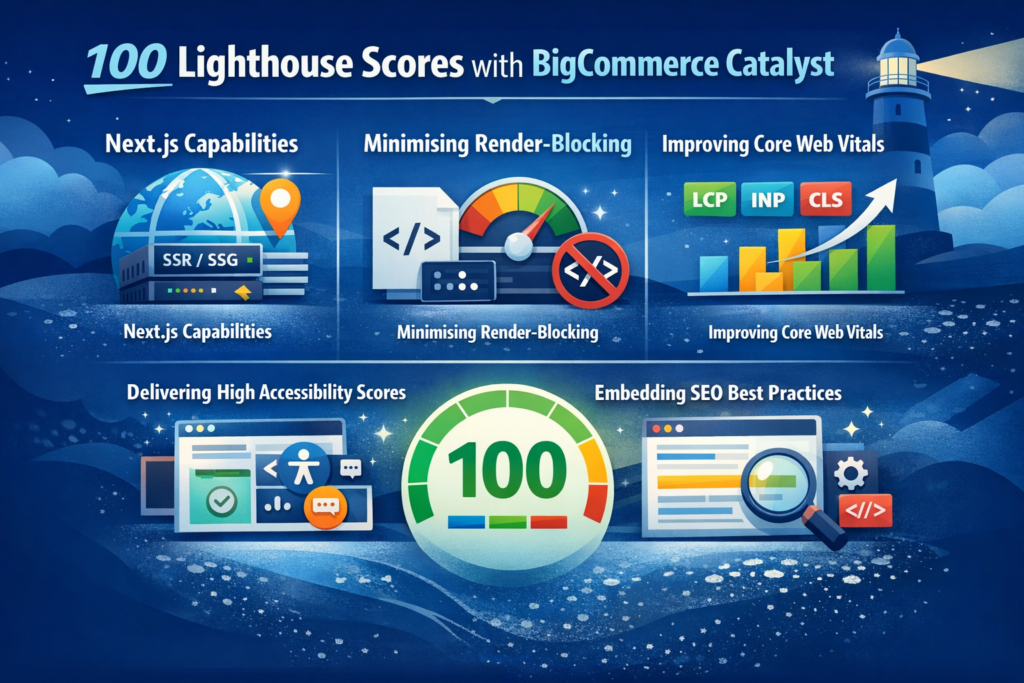
BigCommerce Catalyst enables high Lighthouse scores by:
- Leveraging Next.js capabilities such as server-side rendering (SSR) that renders the page on the server side and quickly presents a ready-to-view HTML to the user, Static Site Generation (SSG) that uses pages pre-built in advance for instant loading, and edge delivery that serves content from a server located closer to the user. These rendering strategies significantly reduce load times.
- Minimizing render-blocking resources with modern JavaScript practices and optimized asset loading
- Focusing on improving Core Web Vitals to meet Google’s real-user experience benchmarks
- Delivering high accessibility scores using clean semantic HTML and standards-aligned components
- Embedding SEO best practices natively and enabling cleaner, more crawlable pages
These technologies significantly improve overall site performance. BigCommerce Catalyst also integrates performance, SEO, and accessibility into the framework, unlike the legacy frameworks that add them later, like an afterthought. As a result, you get faster storefronts, higher search visibility, improved customer experience and customer satisfaction from smoother user interactions, and a measurable boost in engagement and conversions.
Business Impact: When and Why Upgrading to BigCommerce Catalyst Makes Sense
If you have a limited product catalog, predictable traffic, a stable business that does not require massive scaling, and a site that does not require frequent design changes, advanced performance optimization, or consistently high Lighthouse scores, then legacy frameworks like BigCommerce Stencil are adequate. They offer stability without the complexity of a full architectural shift.
Example: A B2B eCommerce business with repeat buyers that sells medical consumables, such as gloves, syringes, and masks, typically does not need a platform upgrade. It can remain on BigCommerce Stencil.
On the other hand, BigCommerce Catalyst stands out when merging performance with business outcomes. So, if you have massive, ever-expanding product catalogs, unpredictable traffic spikes and transaction volumes, mobile-first stores, SEO-driven eCommerce brands that need consistently high Lighthouse scores, and a business that requires design flexibility and rapid expansion, then it is crucial to go for a platform upgrade to BigCommerce Catalyst.
With Catalyst, you can achieve website speed and performance, higher conversions, improved engagement, and faster innovation cycles, while future-proofing your storefront.
Example: A B2C fashion and lifestyle brand that lists thousands of SKUs, drops a few products frequently, expands the catalog periodically, runs flash sales frequently, introduces new collections regularly, and enjoys heavy mobile traffic and transaction volume requires a high-performance storefront.
For promotions and campaigns, it requires highly personalized landing pages, rapid design iterations, and the ability to manage traffic spikes. It demands faster rendering, better Core Web Vitals, and flexible frontend control.
In this scenario, upgrading to BigCommerce Catalyst enables:
- A headless, highly flexible Next.js-powered storefront
- Lightning-fast page loads
- Consistently high Lighthouse scores
- Scalability needed to support growth without performance degradation
Final Thoughts: The Future of High-Performance Storefronts
BigCommerce Catalyst redefines the eCommerce storefronts. It transforms eCommerce sites with modern storefront designs, headless flexibility that enables independent development of frontend and backend, Next.js performance, and built-in SEO support. It aligns speed, accessibility, and scalability into a single framework and enables your eCommerce site to achieve a consistently high Lighthouse score, even a 100. For brands serious about performance and growth, Catalyst is not just an upgrade; it is the new standard for BigCommerce storefronts.
To upgrade your storefront with BigCommerce Catalyst from Stencil and future-proof your business, contact Arizon Digital. With a dedicated team of experts and a proven track record of successfully migrating numerous online stores to BigCommerce Catalyst, Arizon Digital offers platform upgrading services tailored to meet your unique business needs.
FAQs
1. What is Catalyst in BigCommerce?
BigCommerce Catalyst is a modern, headless storefront framework. It features a decoupled, API-driven architecture that enables faster performance, improved Lighthouse scores, and better scalability.
2. What is the difference between Stencil and Catalyst in BigCommerce?
Stencil is a theme-based, tightly coupled storefront system that follows a monolithic architecture. Catalyst is a headless commerce storefront framework that offers superior performance, flexibility, and optimization through modern frontend technologies.
3. What is a good Lighthouse performance score?
A good Lighthouse performance score is typically above 90. With optimal speed, stability, responsiveness, and SEO performance aligned with Google’s Core Web Vitals benchmarks, a 100 Lighthouse score is possible.
4. What is the Lighthouse index?
The Lighthouse index is a composite performance metric that aggregates various website performance parameters, such as loading speed, interactivity, and visual stability, to estimate how quickly a page becomes usable.
5. Does the Lighthouse score affect SEO?
Yes. While not a direct ranking factor, Lighthouse scores reflect Core Web Vitals and UX quality, which significantly influence search visibility and overall SEO performance.


